How To Cycle Sync Your Life as a Busy Mother
Here I am sharing how you can cycle sync your life as a busy mother. You will learn a brief overview of how to eat, exercise, work and mother in accordance with your hormonal cycle.

The last few days, I’ve been feeling flat without explanation.
In the middle of the day, while the kids are running around the house, my husband walks in from his office and looks at me concerned.
“What’s wrong?”
I respond apathetically.
“I actually don’t know. I just feel flat.”
I’m smack bang in the middle of my luteal phase.
The phase where your progesterone dips (if you’re not pregnant) and you typically go through waves of sadness, snappiness or edginess.
I shift between those three emotions. And my whole family feels it.
Why did you give us women a month long cycle while our men just get a 24 hour cycle, Lord?
It seems unfair, if I’m being honest.
But there’s a beautiful reason for it, and it’s our job as women to not live blindly to it, but to live in rhythm with our cycle.
Since having my fourth baby, I have been more intentional with living in line with my cycle as best as I can, without it ruling my life. And while I haven’t gotten it perfect, let me share how you can realistically optimise your cycle as a busy mama in four parts: diet, exercise, work/homemaking and mothering.
How to live in rhythm with your follicular phase:
Diet: In this phase, you should eat foods that are mostly green and fresh. Eat plant-based foods that mimic the body’s natural estrogen, like fermented vegetables, like sauerkraut and kimchi, to prime your microbiome and estrobolome for ovulation. Fresh vegetables like zucchini and carrots and lean protein like chicken and fish. Eat fruit and vegetables steamed or lightly sauteed for optimal nutrients.
Exercise: As your body gains more energy after your menstruation phase, you will want to do more cardio-based exercise at first. As your follicular phase progresses, your body will react more efficiently to intense workouts. If your hormones are imbalanced and you experience symptoms like anxiety, fatigue or depression, then don’t overdo it. Keep your exercise at a maximum of 30 minutes.
Work/Homemaking: This is where your creative juices begin flowing. This is where you often have the energy and desire to create something new and out-of-the-ordinary.
Mothering: This is where you have energy to take your kids to new experiences, to organise adventures together or to do something meaningful together. Embrace your time together while you have the energy for it.
How to live in rhythm with your ovulatory phase:
Diet: While your energy is high and your mood is stable, your estrogen surges to a high. If it goes too high, without the right dietary support, you may experience excess estrogen symptoms, like acne. Fill up your body with raw vegetables like spinach, tomato and leafy greens, fruit like strawberries and raspberries and lighter grains like quinoa and buckwheat. Consume foods like raw vegetables, salads, juices, smoothies and pureed foods.
Exercise: Estrogen and progesterone are peaking here, providing you with energy to burn. This is where intense workouts are prime time.
Work/Homemaking: This is where you will have the most energy. Tackle things like rearranging the linen cupboard, deep cleaning the bathroom, or scheduling more intense meetings.
Mothering: This is where you will want to socialise with friends and family. Book play dates with friends, take your kids out for the day, make the most of this time of blissful energy with your kids.

How to live in rhythm with your luteal phase:
Diet: Your body needs more calories as your metabolism speeds up in this phase. So you need foods that are going to support blood sugar levels, like root vegetables, sweet potato, brown rice and avocado. Prepare your vegetables by steaming or boiling them. And consume high fibre food like chickpeas, pears, apples and walnuts. Roasting and baking are optimal ways to prepare foods.
Exercise: In the first few days of this phase, you will still have energy, but not as much energy for high impact exercise. Focus on strength training here and then in the last few days, focus on flexibility, as your body begins to prepare for rest.
Work/Homemaking: this is the phase where you will want to get organised and tie loose ends. Finish a project, complete the task you started the week before. Do everything you need to do before your time of rest in the following phase.
Mothering: Use this phase to work as a team with your family. Organise rooms together, ask them to do certain tasks around the house to ease the burden for you.
How to live in rhythm with your menstrual phase:
Diet: Your hormone levels are at their lowest during menstruation. This is why eating more protein and healthy fats will help your body during this phase. Eating more nutrient-dense foods will help prepare your body for a healthier ovulatory phase. So, eat foods like red meat, kidney beans, buckwheat, blueberries, blackberries and fish. Soups and stews are great to eat in this phase.
Exercise: Your energy levels dip tremendously in this phase. Any form of high intensity exercise during this phase will turn into fat storage, causing muscle wasting. Engage in restful and restorative exercise and take it easy.
Homemaking: This is your time to take it easy. Don’t do anything more than what is essential for you. Take rest stops throughout the day, receive help from loved ones, leave the big tasks for when you reach your follicular phase.
Mothering: In this phase, schedule some down time for yourself if you can, away from your kids. It’s healthy to have some distance and now is the ideal time. Remember to go easy on yourself and communicate with your kids that you need to rest or take it easy.
Remember that it’s okay to follow this as closely or loosely as you please, but it has been a game changer for me just to be aware of which phase I am in and what I need to do to align my life better with it.
Want to dive in deeper?
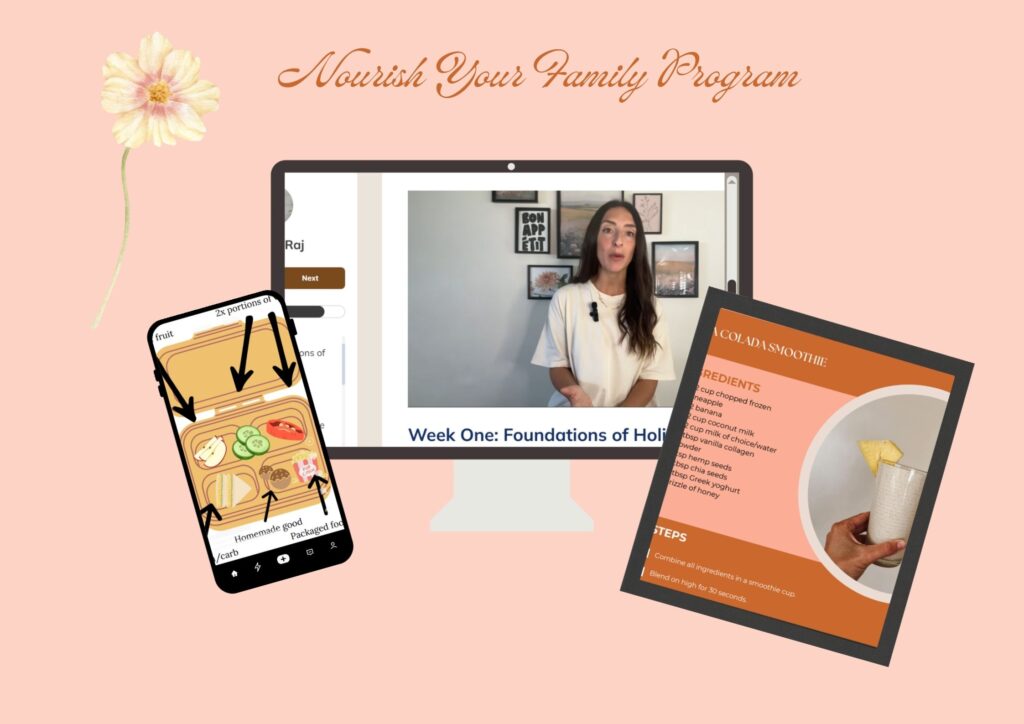
I dive deeper into the topic of hormonal health in my program Nourish Your Family.
Learn how to nourish your body well and your family’s health in just 4 weeks.